
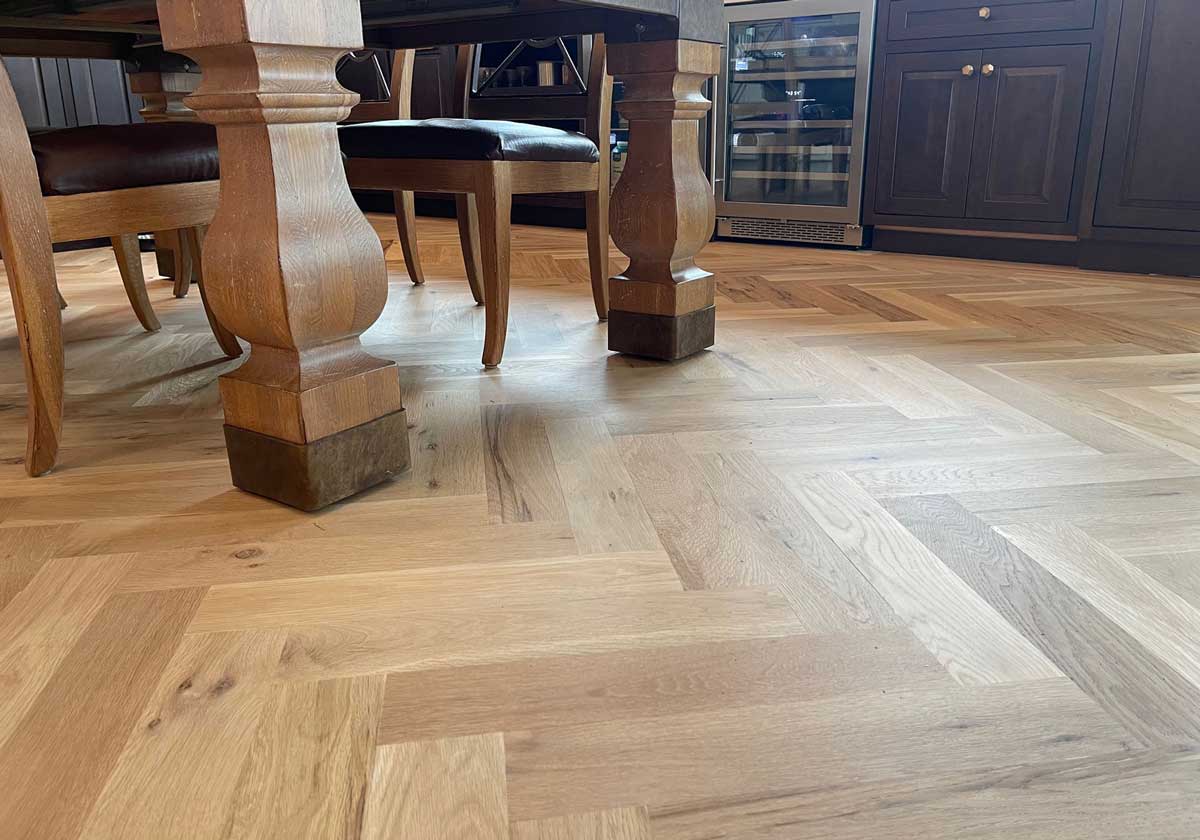
If you're planning new hardwood floors in the mountains of Western North Carolina, one question comes up early: solid or engineered? Both are real wood. Both look beautiful on day one. But they're built differently, and that difference matters in a region where summers are humid, winters are dry and heated, and many homes sit over crawlspaces.
The Short Answer
When it comes to engineered vs. solid hardwood flooring in the mountains, engineered is the safer choice for most homes. Its layered construction moves less as humidity rises and falls, and it can go places solid wood can't, like basements, concrete slabs, and many radiant heat systems. Solid hardwood is still an excellent choice for above-grade rooms in homes with steady, year-round climate control, especially if you want a floor that can be sanded and refinished many times over its life.
How Solid and Engineered Hardwood Are Built
Solid Hardwood
Each solid hardwood board is milled from a single piece of wood, usually about 3/4 inch thick. Because it's the same species all the way through, it can be sanded and refinished many times. The tradeoff is movement. Solid wood absorbs and releases moisture, so it expands in humid months and shrinks in dry ones.
Engineered Hardwood
Engineered hardwood has a top layer of real hardwood, called the wear layer, bonded to a core of cross-layered plywood or high-density fiberboard. Because the core layers run in different directions, they resist the swelling and shrinking that solid boards go through. From above, a quality engineered floor looks the same as solid hardwood.

Why North Carolina's Mountain Climate Changes the Decision
Wood flooring reacts to the air around it, and in the mountains that air changes a lot over the course of a year. Humid summers push moisture into the wood. Cold winters bring forced-air heat and wood stoves that dry it out. Cabins and second homes where the heat or air conditioning gets turned down between visits see the biggest swings of all.
Solid hardwood handles this with small gaps that open in winter and close in summer. That's normal, but when the swings get extreme, solid boards can cup, crown, or gap more than homeowners expect. If you're looking for the best hardwood flooring for North Carolina's mountain climate, stability matters as much as looks. That's why we often recommend engineered hardwood for mountain properties.
Installing Engineered or Solid Hardwood Over a Crawlspace
Crawlspaces are common across Western North Carolina, and they're one of the biggest factors in how a wood floor performs. A damp crawlspace sends moisture up into the subfloor, and the flooring above it pays the price.
National Wood Flooring Association (NWFA) guidelines call for at least 18 inches of clearance between the ground and the underside of the floor joists, with the exposed earth fully covered by a black polyethylene vapor retarder at least 6 mil thick. Before installation, the moisture readings of the flooring and subfloor need to be close. For solid strip flooring under 3 inches wide, NWFA allows no more than a 4 percent difference. For solid planks 3 inches or wider, the limit tightens to 2 percent. Engineered products follow the manufacturer's installation requirements.
Engineered hardwood over a crawlspace is more forgiving than solid, but no floor can make up for a wet crawlspace. If yours has standing water, exposed dirt, or musty air, fix that first. Getting the crawlspace right matters more than which floor you choose.
Basements, Slabs, and Radiant Heat
Solid hardwood should not be installed below grade or directly over concrete. Engineered hardwood can be glued down or floated over a properly prepared slab, which makes it the standard choice for basements and slab-on-grade additions. If your basement has a history of water problems, our guide to LVP vs. hardwood flooring covers when waterproof vinyl is the safer choice.
Radiant floor heat follows a similar pattern. Many engineered hardwoods are approved for radiant systems, while most solid floors are not. Some very stable solid cuts, like rift and quartered boards, can work over radiant heat when the manufacturer approves it. Always confirm radiant compatibility for the specific product before you buy.
Wide Planks Favor Engineered
Wide planks are a big part of the modern mountain look, but the wider a solid board gets, the more it moves. That's why NWFA's moisture tolerance is tighter for wide solid planks. Engineered construction keeps wide boards flatter and more stable, so if you're drawn to extra-wide planks, engineered is usually the better fit.

Refinishing and Lifespan
This is where solid hardwood has the clear edge. With the full thickness of the board to work with, a solid floor can be sanded and refinished many times over its life.
Engineered hardwood can be refinished too, but how many times depends on the thickness of the wear layer. A thick wear layer can handle several full sandings. A very thin one may not handle any. When you compare engineered products, ask for the wear layer thickness in millimeters. It tells you more about long-term value than almost any other spec.
Between full sandings, both types can often be refreshed with a buff and recoat, which renews the finish without removing wood.
What About Cost?
Engineered hardwood isn't automatically the budget option. Entry-level engineered floors can cost less than solid, but premium engineered products with thick wear layers and wide planks are often priced the same as solid or higher. Subfloor prep, installation method, and whether you choose prefinished or site-finished flooring also play a big role in the total. The only way to get a real number is a measured estimate for your space.
Solid vs. Engineered at a Glance
- Construction: Solid is one piece of wood. Engineered is a hardwood wear layer over a cross-layered core.
- Humidity swings: Solid moves more. Engineered moves less.
- Crawlspaces: Both can work when the crawlspace meets NWFA guidelines. Engineered is more forgiving.
- Basements and slabs: Engineered only.
- Radiant heat: Engineered in most cases. Solid only with manufacturer approval.
- Wide planks: Engineered is more stable.
- Refinishing: Solid can be refinished many times. Engineered depends on wear layer thickness.
- Appearance: Identical from above.
Which One Is Right for Your Home?
Choose engineered hardwood if:
- Your home is a cabin or second home where the climate control isn't always running
- You're installing over a concrete slab, in a basement, or over radiant heat
- You want wide planks
- Your crawlspace has had moisture problems in the past, even after they've been fixed
Choose solid hardwood if:
- The rooms are above grade with steady, year-round heating and cooling
- You plan to stay in the home for decades and want the most refinishing potential
- You're matching or extending existing solid hardwood floors
How Arbor Zen Helps You Choose
Every hardwood installation we do starts with a free consultation, where our team measures your space and assesses your subfloor. Before any flooring goes down, we take moisture readings and let the wood acclimate to your home, which typically takes 5 to 7 days depending on site conditions. From there, we recommend the floor and installation method that fit your home, whether that's nail-down, glue-down, or floating.

Our prefinished hardwood collection includes both solid and engineered options from brands like Hallmark Floors, RIVA, Allwood, and Palmetto Road. Our unfinished hardwood line is built for homeowners who want a custom, site-finished floor. You can see samples in person at our Black Mountain and Conover showrooms. And for every installation, we plant 25 trees through our 25 Tree Promise.
Frequently Asked Questions
Is engineered hardwood cheaper than solid hardwood?
Not always. Entry-level engineered can cost less, but premium engineered floors with thick wear layers and wide planks are often priced like solid hardwood. Your total also depends on subfloor prep, installation method, and finish. A free estimate gives you real numbers for your space.
How long does a hardwood floor installation take?
Plan for 5 to 7 days of acclimation before installation begins. After that, prefinished flooring typically installs in 2 to 4 days. Unfinished flooring that's sanded and finished on site typically takes 5 to 10 days.
Is engineered hardwood as durable as solid hardwood?
On the surface, yes. Scratch and dent resistance comes from the wood species and the finish, not from what's underneath. The difference shows up over decades: solid hardwood can be refinished more times, while engineered hardwood's refinishing life depends on its wear layer.
Does engineered hardwood hurt resale value?
Engineered hardwood is real wood, and most buyers see it that way. Some buyers still prefer solid, especially in higher-end homes, but a quality engineered floor suited to the home's conditions will do more for resale than a solid floor that's cupping or gapping.
How do I protect hardwood floors from humidity swings?
Keep indoor conditions as steady as you can all year. Run a dehumidifier in humid months and a humidifier when the heat is on. In vacation homes, leave the HVAC at a moderate setting instead of shutting it off. Your flooring manufacturer usually lists the humidity range its warranty requires, so check it and keep a hygrometer in the house. For more tips, read our hardwood floor care guide.
Do you install hardwood flooring outside Asheville?
Yes. We serve homeowners across Western North Carolina and the Catawba Valley, including Asheville, Black Mountain, Boone, Hickory, Hendersonville, Statesville, and Lake Norman. Visit our showrooms at 116 Montreat Rd in Black Mountain or 301 10th Street NW, Building D, Unit 101 in Conover.
Get Expert Advice Before You Buy
The right floor depends on your home, your subfloor, and how you live. Schedule a free estimate and we'll assess your space, check moisture conditions, and help you choose between solid and engineered with confidence. Call 828.528.3150 or book a free consultation online.

Share:
Arbor Zen's 25 Tree Promise: Reforestation Made Simple
LVP vs. Hardwood Flooring: Which Is Right for Your Western NC Home?